





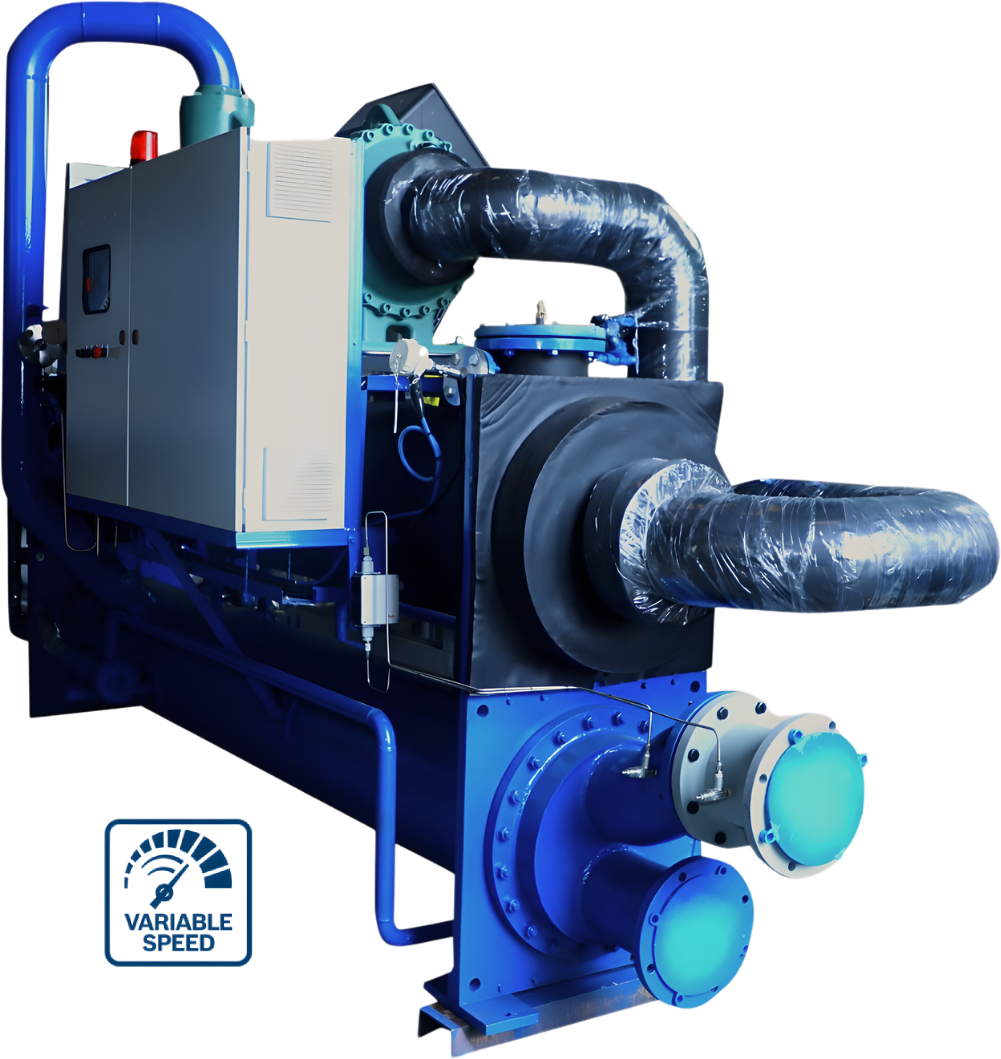
Water Cooled Inverter Screw Chillers
150Kw to 3000Kw
- Inverter driven and Fixed Speed Option
- Compact
- Efficient
- Stepless Capacity Control
- Fully PLC Controlled with MODBUS
- Pressure & Temperature on Transmitter






Options...
Water Cooled Inverter Screw Chillers
Water Cooled Inverter Screw Chillers are advanced industrial cooling systems designed to provide reliable temperature control with improved efficiency under changing cooling loads. These chillers combine the robust performance of screw compressor technology with inverter-based variable-speed operation. This allows the compressor to adjust its speed according to the actual cooling requirement instead of operating continuously at a fixed speed.
For industries where cooling demand varies throughout the production cycle, this technology can provide better part-load performance, stable chilled-water temperatures and efficient operation. Reynold India offers Water Cooled Inverter Screw Chillers for industrial and process-cooling applications where continuous and dependable cooling is important.
What Is a Water Cooled Inverter Screw Chiller?
A Water Cooled Inverter Screw Chiller is a refrigeration system that uses a screw compressor with variable-speed inverter technology to produce chilled water. Unlike an air-cooled system, heat from the refrigerant is rejected through a water-cooled condenser. The condenser-water circuit is generally connected to a cooling tower or another suitable heat-rejection system.
The inverter controls the operating speed of the compressor based on the required cooling capacity. When the cooling demand decreases, the compressor can reduce its speed. When the process requires more cooling, the compressor increases its operating speed.
This makes the system particularly suitable for applications where the cooling load is not constant throughout the day.
How Does a Water Cooled Inverter Screw Chiller Work?
The chiller operates using the basic vapour-compression refrigeration cycle.
Warm return water from the process enters the evaporator. Refrigerant inside the evaporator absorbs heat from the water, thereby reducing the water temperature. The chilled water is then circulated back to the connected process or equipment.
The heated refrigerant moves to the screw compressor. The inverter adjusts compressor speed according to the cooling requirement. The compressor increases the refrigerant pressure and temperature before sending it to the water-cooled condenser.
In the condenser, heat is transferred from the refrigerant to the condenser-water circuit. The heated condenser water is then sent toward the cooling tower or other heat-rejection equipment. After condensation, the refrigerant passes through the expansion device, where its pressure and temperature are reduced. It then returns to the evaporator and the cycle continues.
The variable-speed compressor allows the refrigeration system to continuously respond to changes in cooling demand.
Inverter Technology in Screw Chillers
One of the major advantages of an inverter screw chiller is its ability to vary compressor speed over a broad operating range. Reynold India's CSVH-series configuration incorporates an inbuilt inverter and is designed for variable-speed operation. The company's product information states that the system can operate across a substantially wider compressor speed range than a conventional externally VFD-controlled screw chiller.
This capability is important because industrial processes rarely operate at exactly the same cooling load all the time. Production changes, machine loading, ambient conditions and process cycles can all affect the required cooling capacity.
Instead of relying only on conventional capacity steps, inverter technology allows the compressor to modulate its output more closely to the actual requirement.
Key Features of Reynold India Water Cooled Inverter Screw Chillers
- Inbuilt Inverter Technology: The compressor incorporates inverter-based speed control, allowing cooling capacity to respond to changing process requirements.
- Variable-Speed Screw Compressor: The variable-speed screw compressor is designed for applications requiring continuous and flexible cooling capacity. It can reduce unnecessary full-load operation when the actual cooling requirement is lower.
- Permanent Magnet Motor: Selected larger compressor configurations use permanent magnet motors instead of conventional asynchronous motors. Permanent magnet motor technology can offer strong efficiency characteristics, particularly during part-load operation.
- Integrated Oil Management: The compressor configuration includes an integrated multi-stage oil separation arrangement and oil filter. Proper oil management is essential for maintaining reliable screw-compressor operation.
- Automatic VI Control: The system incorporates an automatic two-step VI slider. Variable internal volume ratio control helps the compressor operate more appropriately across different operating conditions.
- MODBUS Communication: Inbuilt MODBUS communication allows the chiller control system to exchange operating information with compatible supervisory or building/process management systems. This can be useful for centralized monitoring and plant automation.
- Intelligent Oil-Level Monitoring: At low compressor speeds, proper oil return is an important consideration in screw refrigeration systems. Reynold India's inverter-based configuration uses intelligent monitoring and control to monitor oil conditions and adjust compressor operation when required.
Benefits of Water Cooled Inverter Screw Chillers
- Better Part-Load Efficiency: Many industrial processes spend a significant amount of operating time below their maximum cooling load. Variable-speed operation allows the compressor to reduce its output when less cooling is required, which can improve part-load efficiency.
- Reduced Energy Consumption: Because the compressor can better match its capacity with the actual cooling demand, unnecessary energy use associated with operating at higher capacity than required can be reduced. Actual savings depend on the load profile, chilled-water temperatures, condenser-water conditions, operating hours and overall system design.
- Stable Process Temperature: Accurate capacity modulation helps the chiller respond to changing thermal loads. This is particularly useful for manufacturing processes where water temperature consistency is important.
- Reliable Continuous Operation: Screw compressor technology is widely used for medium- and large-capacity industrial refrigeration and cooling applications. When correctly selected, installed and maintained, it can support continuous industrial operation.
- Efficient Heat Rejection: Water is an effective heat-transfer medium, and water-cooled condenser systems can provide efficient heat rejection when the condenser-water system and cooling tower are properly designed and maintained.
- Reduced Compressor Cycling: Variable-speed operation can reduce the need for frequent compressor starts and stops. Smoother capacity adjustment can be beneficial for applications with fluctuating cooling requirements.
Applications of Water Cooled Inverter Screw Chillers
Water Cooled Inverter Screw Chillers are suitable for many industrial and commercial applications.
- Plastic Industry: Plastic injection moulding, extrusion, blow moulding and pipe manufacturing require reliable cooling for moulds, machines and process circuits. Stable chilled-water temperature can support consistent production conditions.
- Pharmaceutical Industry: Pharmaceutical plants use controlled cooling for various manufacturing processes, HVAC systems and equipment. The chiller should be selected according to the required process temperature, flow and operating conditions.
- Food and Beverage Industry: Food and beverage manufacturing frequently requires process cooling for production equipment, water circuits and temperature-sensitive processes.
- Chemical and Process Industries: Chemical plants often have variable cooling loads and continuous operating requirements. A properly engineered inverter screw chiller can provide flexible cooling capacity for suitable process applications.
- Data Centres and Commercial Facilities: Water-cooled chillers can also be considered for large cooling systems where a central chilled-water and condenser-water infrastructure is available.
- Manufacturing Plants: Machinery, production lines, testing equipment and other industrial processes may require continuous chilled-water cooling. Variable-speed operation is especially useful where the thermal load changes during production.
Water Cooled Inverter Screw Chiller vs Conventional Screw Chiller
A conventional fixed-speed screw chiller generally relies on mechanical capacity control and compressor loading arrangements to respond to changing demand. An inverter screw chiller additionally changes compressor speed, providing another level of capacity modulation.
This makes inverter screw technology particularly attractive when the application has a significant number of operating hours at partial load.
However, the best choice should always be based on the actual load profile. A chiller operating continuously near full load may have different optimization requirements compared with a plant where the cooling demand frequently changes between low and high levels.
Water Cooled Inverter Screw Chiller vs Air Cooled Inverter Screw Chiller
The main difference is the method used to reject heat.
A water-cooled inverter screw chiller uses condenser water and normally requires a cooling tower or equivalent heat-rejection system. An air-cooled system rejects heat directly to the surrounding air.
Water-cooled systems can be attractive for installations where cooling-tower infrastructure is available and high operating efficiency is a priority. Air-cooled systems can be simpler where water availability or cooling-tower installation is a concern.
The selection should consider water availability, ambient conditions, installation space, maintenance requirements, energy costs and the complete lifecycle cost of the cooling system.
How to Select the Right Water Cooled Inverter Screw Chiller?
Before selecting a chiller, the complete application should be evaluated. Important parameters include:
- Required cooling capacity
- Chilled-water inlet and outlet temperatures
- Required chilled-water flow
- Condenser-water temperature and flow
- Cooling load profile
- Operating hours
- Site ambient conditions
- Electrical power availability
- Water quality
- Cooling tower availability
- Installation space
- Control and communication requirements
- Future capacity requirements
A proper heat-load calculation should be completed before finalizing the chiller capacity. Oversizing or undersizing the equipment can affect system performance and operating economics.
Why Choose Reynold India?
Reynold India provides industrial and process cooling solutions for applications across multiple industries. Its product portfolio includes water-cooled screw chillers, inverter screw chillers, scroll chillers and customized industrial cooling systems.
For customers looking for a Water Cooled Inverter Screw Chiller Manufacturer in India, Reynold India can develop cooling solutions according to the application's required capacity, temperature conditions, process requirements and installation environment.
The company also positions its Water Cooled Inverter Screw Chiller for plastic-processing applications, including demanding processes where stable and efficient cooling is required.
Conclusion
Water Cooled Inverter Screw Chillers are a strong choice for industrial applications requiring reliable cooling, variable capacity control and efficient part-load operation. By combining screw compressor technology with inverter-driven speed control, these systems can respond more effectively to changing cooling requirements.
Features such as an inbuilt inverter, permanent magnet motor options, integrated oil management, automatic VI control and MODBUS communication make this technology suitable for modern industrial cooling systems.
For plastic processing, pharmaceutical manufacturing, food and beverage production, chemical plants, manufacturing facilities and other applications, the correct chiller should be selected after evaluating the actual cooling load, temperatures, flow rates, operating hours and site conditions.
If you are planning a new cooling system or replacing an existing chiller, Reynold India can help you evaluate your application and select a suitable Water Cooled Inverter Screw Chiller based on your actual process requirements.